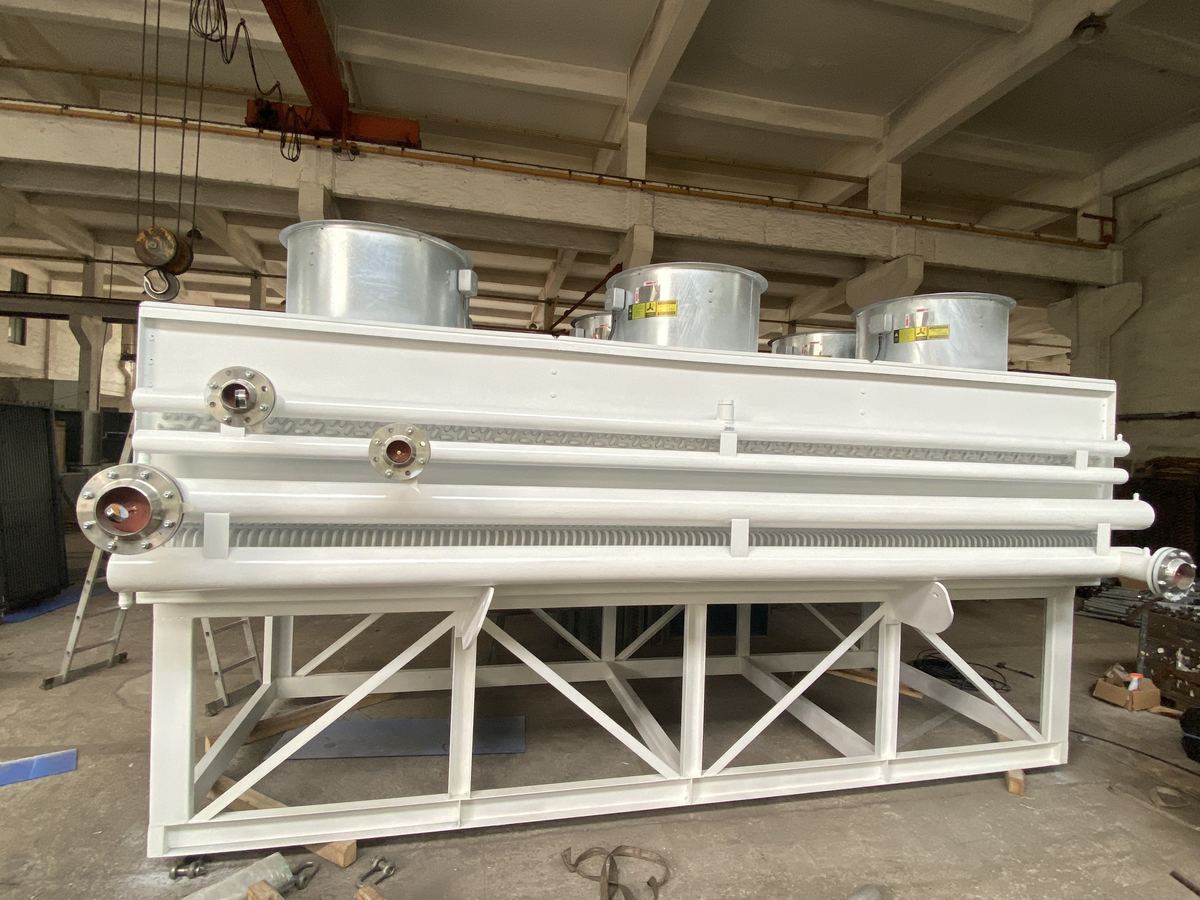
Overview
An air cooler, or air-cooled heat exchanger, passes the process fluid through finned tubes and uses ambient air as the cooling medium. The attraction is independence from cooling water: no cooling tower, no circulating water treatment and no water consumption, which matters on sites where water is scarce or expensive. The trade-off is that the achievable outlet temperature tracks the ambient dry-bulb temperature, and that fan power becomes the running cost.
Features
- No cooling water circuit, no cooling tower and no water consumption
- Tube bundle and fan selected together for the required approach temperature
- Tube materials matched to the process fluid
- Fin spacing set by whether the site air is dusty
- Structural design for outdoor installation on request
- Running cost dominated by fan power rather than pump power
Materials and specifications
| Cooling medium | Ambient air, with or without forced draught fans |
| Tube material | Carbon steel, stainless steel, copper |
| Fin material | Aluminium, copper, stainless steel |
| Process side | Liquids, process fluids, gases |
| Configuration | Forced or induced draught, horizontal or vertical bundle |
Typical applications
| Application | Description |
|---|---|
| Water-scarce sites | Replacing a water-cooled circuit where water is unavailable or costly. |
| Chemical and petrochemical | Cooling process streams and inter-stage duties. |
| Power generation | Auxiliary cooling duties. |
| Equipment cooling | Cooling hydraulic, lubricating and other auxiliary fluids. |
FAQ
When is an air cooler better than a water-cooled exchanger?
When cooling water is unavailable, expensive, or the site cannot support a cooling tower and water treatment plant. It also suits sites where the ambient air is reliably cool and continuous water consumption would be a problem.
What temperature can an air cooler reach?
The outlet temperature of the process fluid cannot fall below the ambient dry-bulb temperature, and in practice an approach margin is always needed. If your duty requires cooling below ambient, an air cooler is the wrong choice.
How do you handle dusty or hot environments?
Fin spacing is widened so the bundle does not clog, and the arrangement is chosen so the bundle can be cleaned. For hot environments the approach margin has to be re-checked against the design ambient temperature, not the annual average.
Can you combine a fin coil with an air cooler?
Yes. Fin coil units are essentially the air-side counterpart of the same construction. If you need both air cooling and process cooling in one project, both can be designed together with a common tube and fin system.