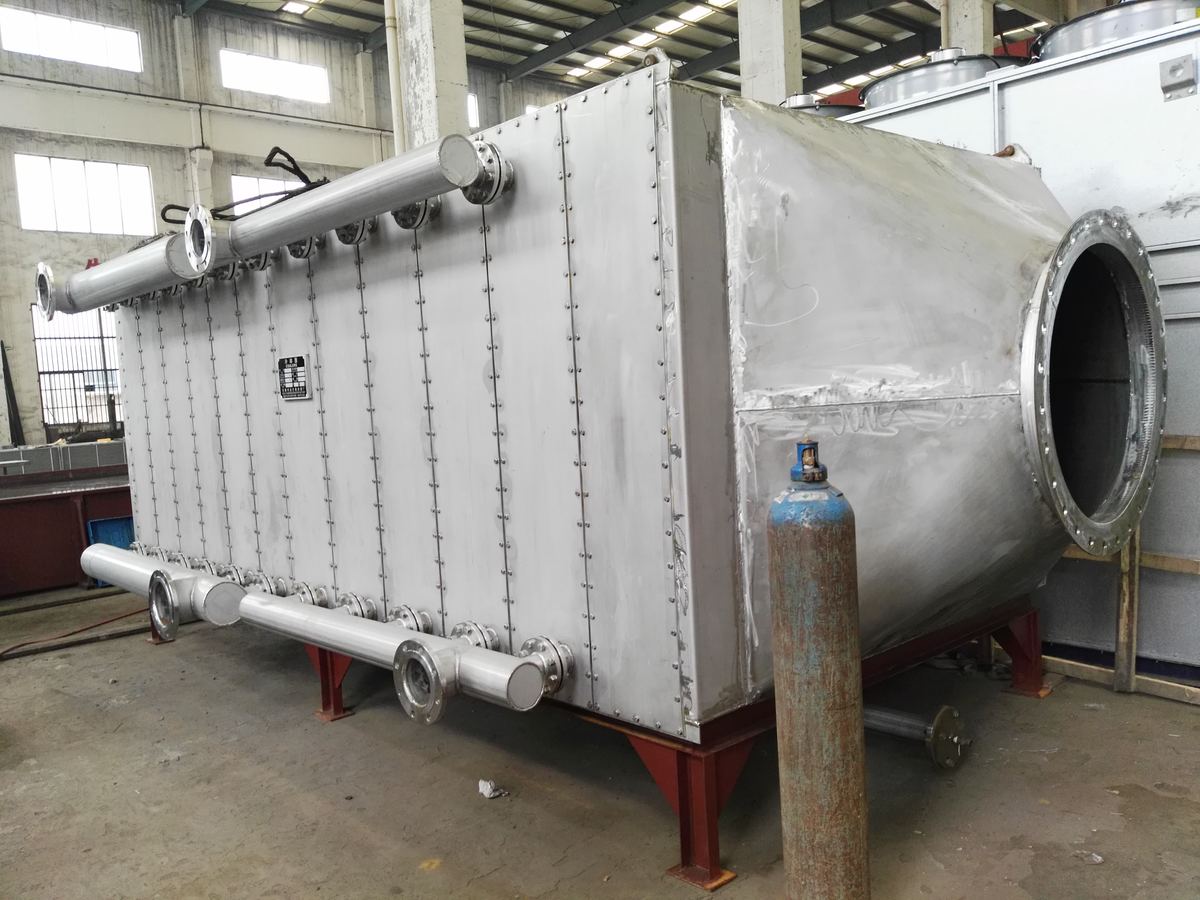
Overview
The governing question in flue gas heat recovery is not the surface area but whether the cold-end wall temperature will fall below the acid dew point. When it does, water vapour and acidic components condense on the tube wall and corrosion proceeds far faster than in a dry gas duty. This is why a large share of heat recovery units fail within a couple of years of commissioning.
Features
- Cold-end wall temperature checked before surface area is fixed
- Materials selected against acid dew point corrosion and dust loading
- Carbon steel, ND steel, stainless steel and enamel-coated finned tubes
- Fin spacing widened for dust-laden flue gas to limit blockage
- Soot blowing or rapping systems available for high-dust duties
- Condensing design available for operation below the acid dew point
Materials and specifications
| Heat sink | Hot water, process hot air, steam |
| Tube material | Carbon steel, ND steel, 304 / 316L stainless steel, enamel-coated |
| Fin type | High-frequency welded, wound, integral rolled |
| Dust handling | Wider fin spacing, in-line arrangement, soot blowing or rapping |
| Insulation | Thermal insulation and cladding for outdoor duty |
Typical applications
| Application | Description |
|---|---|
| Boiler flue gas | Reducing stack temperature and recovering heat into boiler feed or make-up water. |
| Kiln and furnace exhaust | Cooling exhaust gas before dust collection or desulphurisation. |
| Drying plant exhaust | Recovering heat from dryer exhaust back into the process. |
| Condensing duty | Cooling flue gas below the acid dew point to recover latent heat from water vapour. |
FAQ
Why does the acid dew point matter so much?
In flue gas containing sulphur, water vapour and acidic components condense into acid on the tube wall once the wall drops below the acid dew point. Corrosion then proceeds much faster than in dry conditions. The cold-end wall temperature is therefore a hard constraint: it has to be satisfied before surface area is even discussed, otherwise the unit will have a short life.
Can you recover heat below the acid dew point?
Yes. Running below the acid dew point recovers the latent heat released as water vapour condenses, which is substantially more than the sensible heat available over the same temperature drop. The price is that the heat transfer surface sits permanently in acidic condensate, so corrosion-resistant materials and condensate collection and neutralisation have to be designed in from the start. Our material selection follows the measured condensate condition.
Which material is used for condensing duty?
It depends on the condensate. For neutral to mildly acidic condensate with low chloride, 304 stainless steel is workable. For stronger acidity and sulphur-bearing fuel, 316L is used for its resistance to acid and chloride pitting. Strongly corrosive or chloride-bearing duties call for enamel-coated finned tubes, and where sulphuric acid dew point corrosion dominates, ND steel is the economical choice.
What about dust?
Fin spacing and tube arrangement have to give way to the dust loading. We widen the fin spacing, use an in-line arrangement and add soot blowing or rapping. The cleaning interval is set by the actual dust deposition rate, not by an assumed figure.
How do you decide whether a project is worth it?
By three quantities: how much heat can be recovered, how many hours the recovered heat is actually used, and what the displaced fuel or steam costs. We calculate on the year-round load rather than the nameplate rating, and give you a recovery estimate and payback period to support the decision.