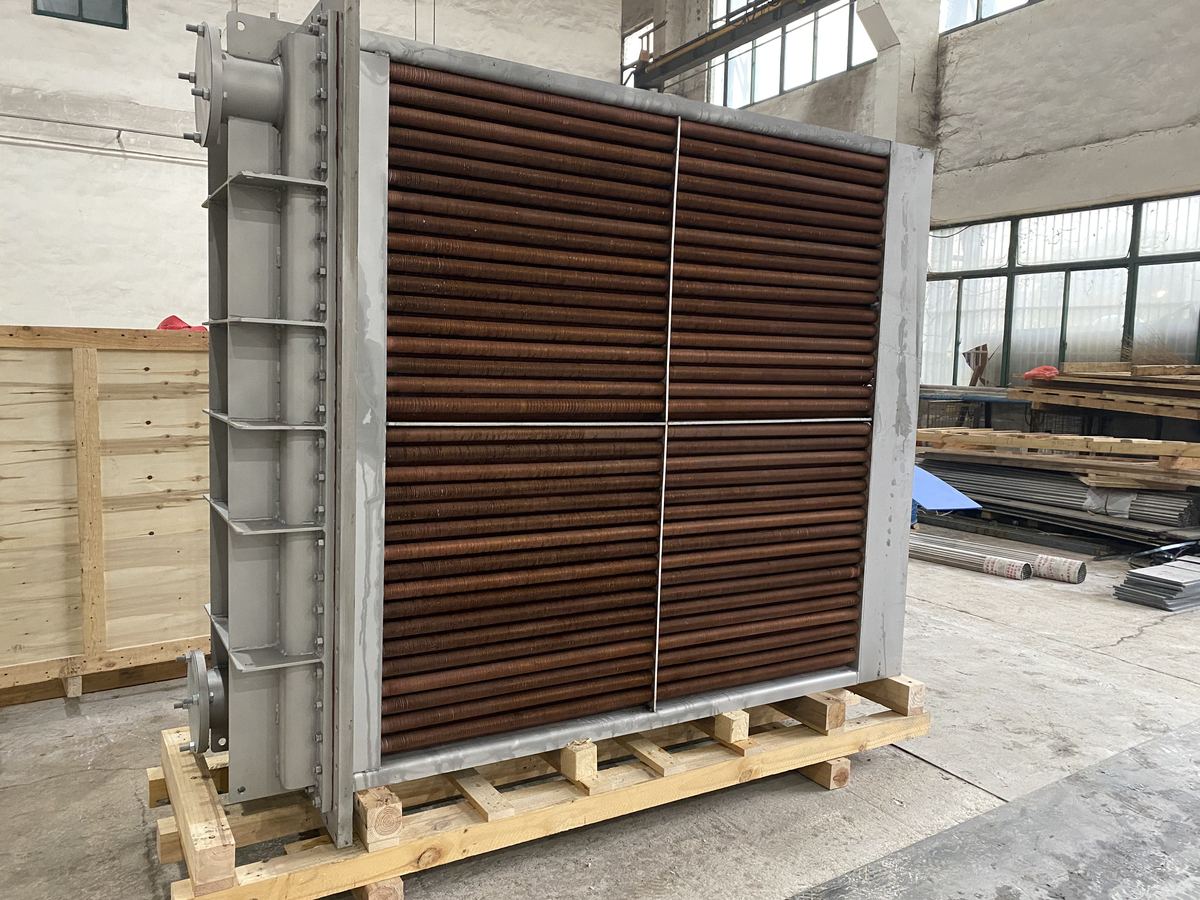
Overview
A finned tube heat exchanger puts one medium inside the tubes and passes the other across the outside, where fins multiply the surface area. Because the gas-side film coefficient is far lower than the liquid- or steam-side one, adding fins on the gas side is the most effective way to raise the overall heat transfer within a given envelope. We build the tube bundle, the frame and the connections as one unit, sized to the duty rather than picked from a catalogue.
Features
- Tube materials: copper, stainless steel (304 / 316L), carbon steel and ND steel
- Fin materials: copper, aluminium, stainless steel and carbon steel
- Fin types: wound, sleeve-on, embedded, integral rolled, high-frequency welded and brazed
- Fins on the gas side to compensate for the low gas-side film coefficient
- Header, frame and connections manufactured to match your duct and equipment
- Built for pressure-bearing duty
Materials and specifications
| Tube material | Copper, stainless steel (304 / 316L), carbon steel, ND steel |
| Fin material | Copper, aluminium, stainless steel, carbon steel |
| Fin type | Wound, sleeve-on, embedded, integral rolled, high-frequency welded, brazed |
| Heating media | Saturated steam, superheated steam, hot water, thermal oil |
| Cooling media | Chilled water, cooling water, ambient air |
| Gas side | Air, flue gas, process gas |
| Configuration | Tube bundle with frame and inlet / outlet connections |
Typical applications
| Application | Description |
|---|---|
| Air heating | Steam, hot water and thermal oil coils for drying lines, space heating and process air. |
| Air cooling | Chilled water coils for HVAC and process cooling; air-cooled units for water-scarce sites. |
| Flue gas heat recovery | Cooling flue gas and recovering the heat into water, air or steam. |
| Special duties | Heat storage bundles and process gas coolers where sealing and material compatibility dominate. |
FAQ
How do I choose between copper and stainless steel tubes?
Copper gives the best thermal conductivity and is the usual choice for steam and hot water duties. Stainless steel is chosen when the medium or the surrounding atmosphere is corrosive, or when cleanliness matters and no particles may be shed. 316L is used instead of 304 where chlorides are present.
Which fin type should I specify?
It depends on the duty rather than preference. Wound fins are the general-purpose choice and cost-effective. Sleeve-on fins let the fin material differ from the tube, typically aluminium fins on stainless or carbon steel tubes. Integral rolled fins are formed from the tube wall itself and have no contact resistance. High-frequency welded fins hold up to high temperature and repeated thermal cycling, which suits flue gas duties.
Can you design the bundle to fit our equipment?
Yes. Send us the available envelope, duct cross-section, connection positions and mounting method, and we design the bundle around those constraints instead of asking the equipment to accommodate the coil.
Do you supply samples or prototypes?
Yes. We routinely work from prototype through to series production, which is how we develop most custom units. Validation is done on the prototype before volume supply begins.