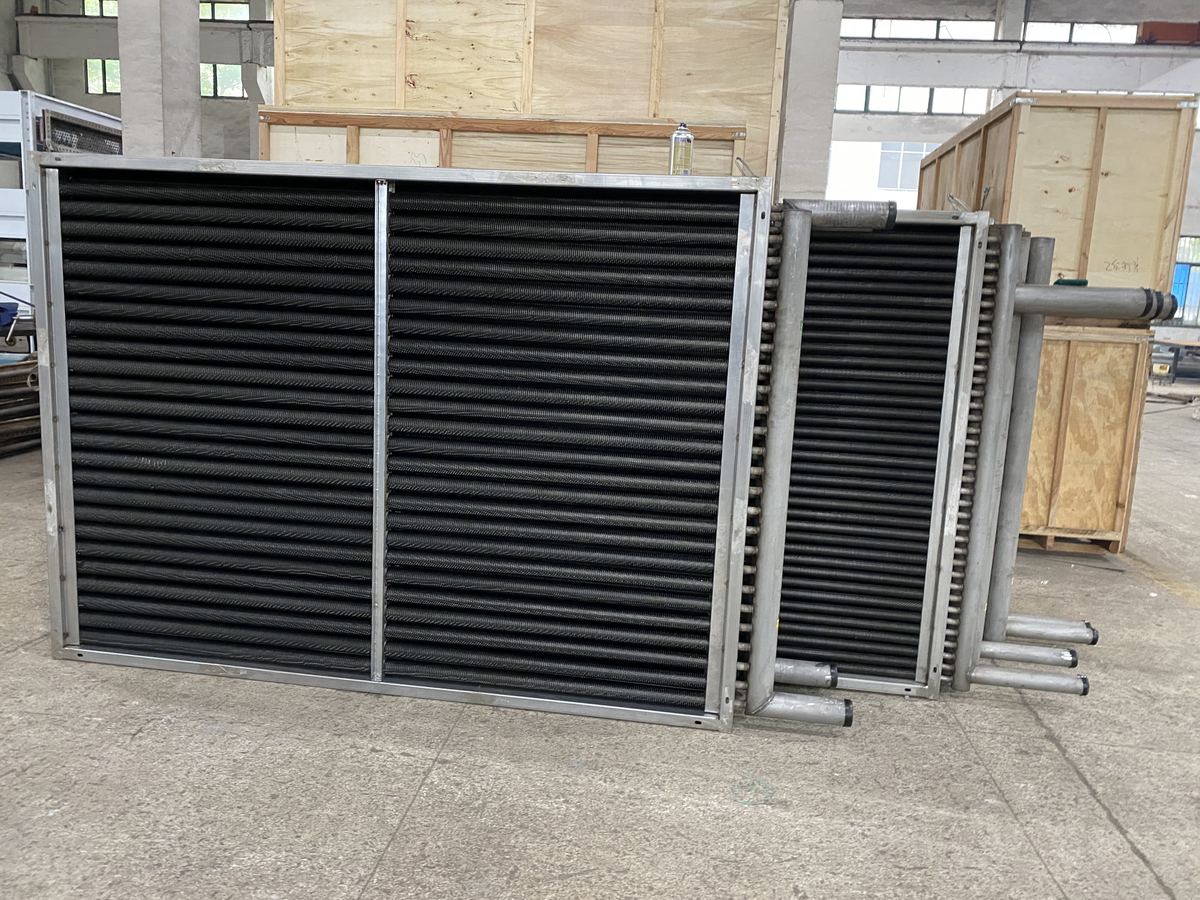
Overview
Finned tube selection can be split into three independent questions: which tube material, which fin material and how the fin is attached. Mixing them together usually leads to a compromise that is good at none.
Tube material governs corrosion resistance and pressure capability. Fin material governs surface area, cost and galvanic compatibility with the tube. The bonding method governs contact resistance and the maximum operating temperature.
Features
- Tube materials: copper, stainless steel 304 / 316L, carbon steel and ND steel
- Fin materials: copper, aluminium, stainless steel and carbon steel
- Bonding methods: wound, sleeve-on, embedded, integral rolled, high-frequency welded and brazed
- Material selection by corrosion, temperature and cleanliness requirement
- 316L for chloride-bearing duty; ND steel or enamel for sulphur-bearing flue gas
- Mixed material designs to balance heat transfer, corrosion life and cost
Tube and fin material combinations
| Combination | Corrosion and temperature | Typical duty | Notes |
|---|---|---|---|
| Copper tube + copper fin | Good thermal conductivity; high-pressure construction possible | Steam heating, HVAC, export projects | Used for high-pressure steam heaters supplied to Russia |
| Copper tube + aluminium fin | Good heat transfer at controlled cost; aluminium has limited corrosion resistance | HVAC and general air heating | Protect the copper / aluminium contact against galvanic corrosion |
| Stainless steel tube + stainless steel fin | Good corrosion resistance for clean and corrosive duty | Cleanrooms, process gas, humid or acid-bearing atmospheres | 304 for general duty; 316L for chlorides and more severe corrosion |
| Carbon steel / ND steel tube + carbon steel fin | High strength and low cost; corrosion resistance depends on the duty | Boiler and kiln flue gas, high-temperature duty | Check the dew point; use ND steel or enamel where sulphur is present |
Fin bonding methods
| Fin type | Characteristics | Typical use |
|---|---|---|
| Wound | Fin is wound tightly and expanded against the tube, giving good contact and low contact resistance | General air heating and cooling; balanced cost |
| Sleeve-on | Preformed fin is slipped over the tube and expanded; fin material can be selected independently | Aluminium fin on stainless or carbon steel tube; corrosion and cost balance |
| Embedded | Fin root is embedded in a groove in the tube wall for a strong mechanical bond | Vibration or applications where fins must not loosen |
| Integral rolled | Fin is formed from the tube wall itself, with no contact resistance | Aluminium tube and fin; high efficiency at lower temperature |
| High-frequency welded | Metallurgical weld gives high bond strength and thermal shock resistance | High-temperature flue gas and repeated start-stop duty |
| Brazed | Whole bundle is brazed for low contact resistance and good sealing | Compact, high-efficiency duty |
The final fin type and tube dimensions are confirmed together with the tube material, fin material and operating temperature.
FAQ
When must a stainless steel finned tube be used?
Give priority to stainless steel when the medium or atmosphere is corrosive, when cleanliness matters and no particles may be shed, or when the coil is cleaned frequently. Use 304 for general corrosion and 316L for chloride-bearing or more severe duty.
How do I choose between 304 and 316L?
Check the chloride content and corrosion severity. 304 is the general choice. 316L contains molybdenum and resists chloride pitting and crevice corrosion better, so it is used for salt, chloride or more aggressive conditions. Confirm against the medium analysis.
What is the difference between high-frequency welded and wound fins?
Wound fins give good contact at moderate cost and suit general duty. High-frequency welded fins form a metallurgical bond with the tube, giving better high-temperature strength and thermal shock resistance for flue gas and repeated start-stop duty.
Where are sleeve-on and integral rolled fins used?
Sleeve-on fins allow the fin material to differ from the tube, commonly aluminium fins on stainless or carbon steel tubes. Integral rolled fins are formed from the tube wall, have no contact resistance and suit aluminium tube and fin construction.
Can carbon steel finned tubes still be used?
Yes. Where there is no corrosive component and the temperature is suitable, carbon steel is the most cost-effective choice. The key check is whether the cold-end wall temperature stays above the dew point.