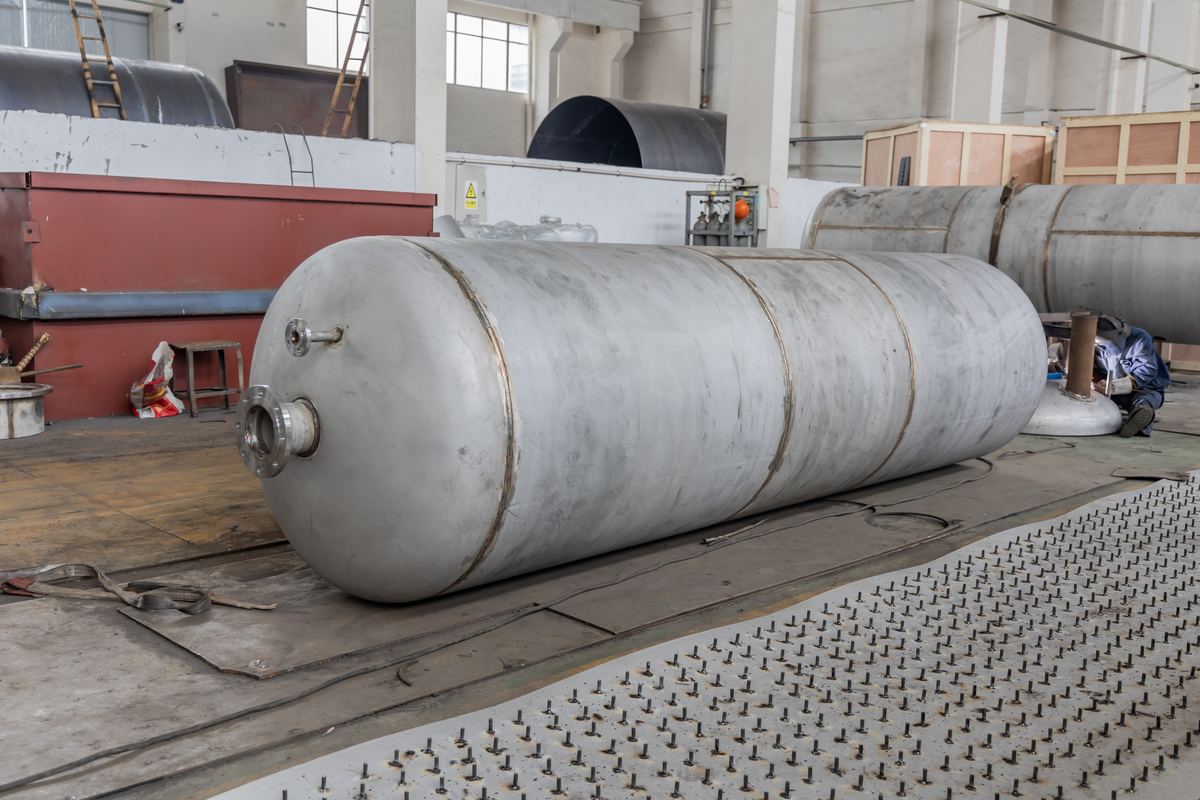
Overview
Shell and tube and spiral plate heat exchangers are general industrial exchangers: the heat transfer surface is formed by tubes or plates, and both media flow in closed channels rather than being heated or cooled by air.
A shell and tube exchanger places a tube bundle inside a cylindrical shell. Tube-side and shell-side materials can differ, and the pressure and temperature range is wide. Fixed tubesheet, floating head and U-tube designs cover different thermal expansion and cleaning needs.
A spiral plate exchanger rolls two parallel plates into spiral channels. The continuous channel is self-cleaning and resistant to blockage, which suits particle-laden, fouling or viscous media. Detachable versions allow mechanical cleaning.
Features
- Shell and tube designs in fixed tubesheet, floating head and U-tube construction
- Spiral plate designs in fixed and detachable construction
- Carbon steel as standard, with stainless steel, copper and titanium options
- Pressure-bearing fabrication and inspection for shell and tube units
- Selection based on medium, pressure, temperature, fouling and cleaning method
Shell and tube vs spiral plate
| Item | Shell and tube | Spiral plate |
|---|---|---|
| Typical construction | Cylindrical shell with tube bundle | Two parallel plates rolled into spiral channels |
| Pressure and temperature | Wide range; pressure-bearing equipment available | Good pressure capability, usually medium and low pressure |
| Medium | Clean or lightly contaminated media | Particle-laden, fouling or viscous media |
| Blockage and cleaning | Tube bundle can be withdrawn for cleaning; solids can block tubes | Self-cleaning channel resists blockage; detachable type for mechanical cleaning |
| Typical industries | Chemical, petrochemical, power, food, pharmaceutical, HVAC | Chemical, oil, food, pharmaceutical, waste heat recovery, metallurgy |
Both are normally supplied in carbon steel, with stainless steel, copper or titanium selected for corrosive duty.
Selection by duty
| Condition | Preferred choice |
|---|---|
| Clean medium with higher pressure or temperature | Shell and tube heat exchanger |
| Frequent tube inspection or mechanical cleaning required | Shell and tube heat exchanger |
| Medium contains solids or tends to foul | Spiral plate heat exchanger |
| Higher viscosity and a compact footprint required | Spiral plate heat exchanger |
| Blockage resistance plus manual cleaning access | Detachable spiral plate heat exchanger |
Typical applications
| Application | Description |
|---|---|
| Chemical | Heating and cooling of process media. |
| Petrochemical | Process heat exchange and condensation. |
| Power | Auxiliary cooling and heating. |
| Food and pharmaceutical | Process heating, sterilisation and cooling. |
| HVAC and waste heat recovery | Heating, cooling and low-temperature recovery. |