Overview
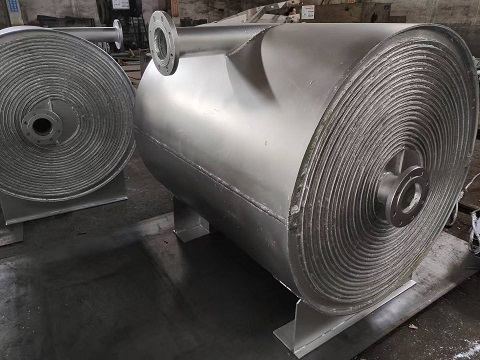
A spiral plate heat exchanger is formed by rolling two parallel plates into spiral channels. The hot and cold media flow in adjacent channels, giving a compact, high-efficiency unit with good self-cleaning behaviour. The continuous channel has no tube bundle or baffle dead zones, so particles are less likely to settle. It suits media that contain solids, tend to foul or have a higher viscosity.
Features
- High heat transfer efficiency in a compact footprint
- Self-cleaning spiral channels resist blockage
- Suitable for particle-laden, fouling and viscous media
- Reliable seals and good pressure capability
- Detachable design available for mechanical cleaning
Materials and specifications
| Type | Fixed or detachable |
| Main material | Carbon steel |
| Optional material | Stainless steel |
| Design inputs | Temperatures, flow rates, allowable pressure drop and solids content of both media |
| Suitable media | Liquids containing particles, prone to fouling or with higher viscosity |
Typical applications
| Application | Description |
|---|---|
| Chemical | Heating and cooling of solids-laden or viscous materials. |
| Oil and gas | Process medium heat exchange. |
| Food and pharmaceutical | Hygienic heat exchange and cooling. |
| Waste heat recovery | Low-temperature heat recovery. |
| Metallurgy | Process water and oil cooling. |
FAQ
What is the advantage over a shell and tube exchanger?
The main advantage is the continuous spiral channel, which resists blockage and is more self-cleaning for particle-laden or fouling media. A shell and tube exchanger remains stronger for high-pressure and standardised duty.
Can a detachable design be supplied?
Yes. A detachable construction is available when mechanical cleaning access is required. State this in the enquiry.